


Guests are arriving soon, the group chat is full of green polos and khakis, and the planned outfit still looks more like an ordinary golf day than a Masters party. The fix isn't adding more golf logos. It's choosing a costume system with a clear visual anchor: a white caddie-style coverall or bib, a green cap, and one personal detail that makes the outfit belong to its wearer.
That combination works for a family photo, a birthday gathering, or a watch party because it reads as a character, not just a dress code. Fit and comfort still matter, especially when children will be moving around or the event runs for hours. A good Masters-themed party outfit should look recognizable in a photograph and feel easy to wear once the camera is put away.
Why the White Jumpsuit and Green Cap Define the Masters Look
Dress a dozen guests in green polos and khakis and you get a golf crowd. Put one of them in a white coverall with a green cap and you get a caddie. For a themed party, the second outcome is the goal: the white uniform and green headwear are the defining cues, and everything else in the outfit is supporting detail.
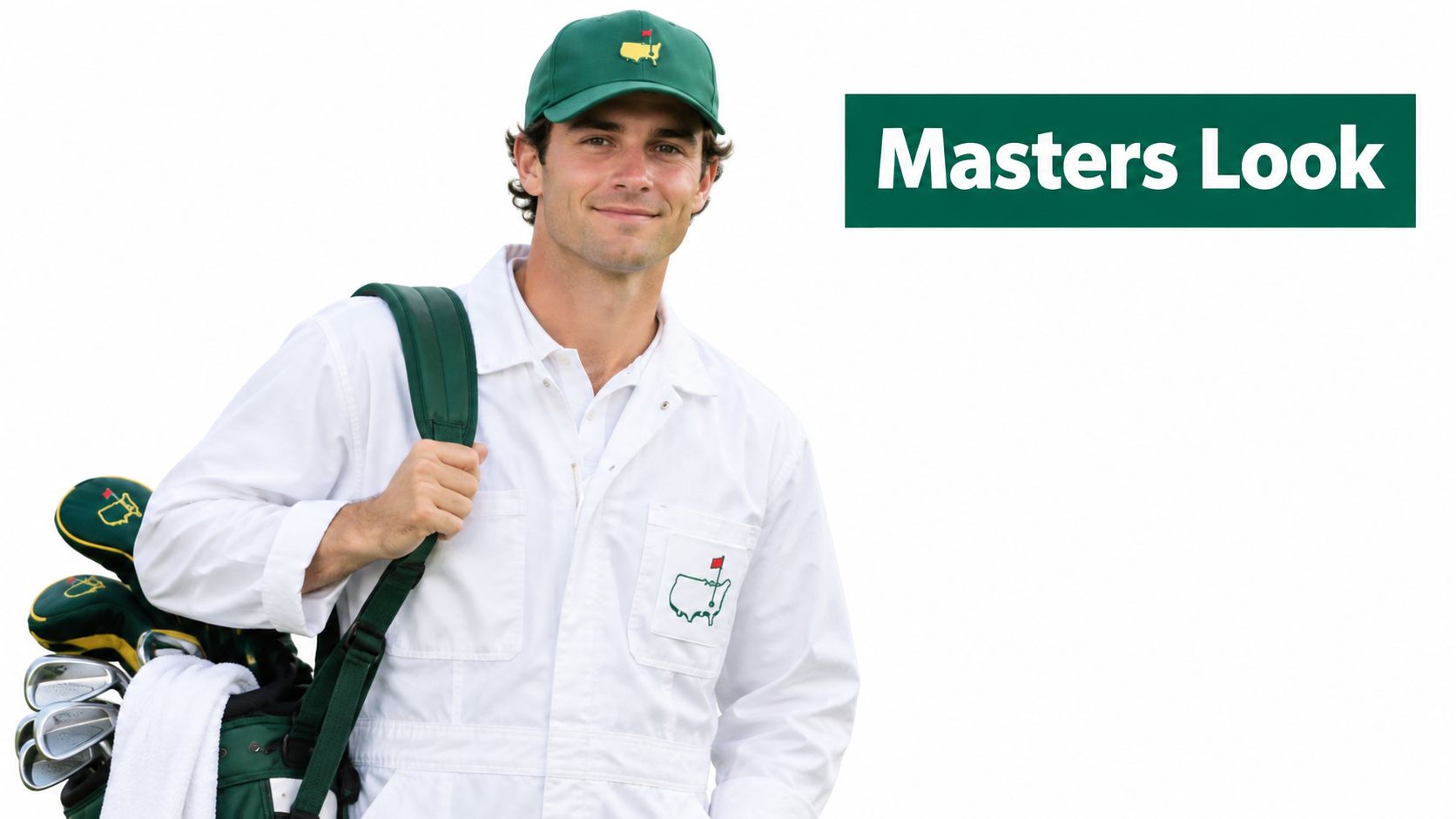
The look has a practical origin. When the Masters began in 1934, caddies reportedly wore ordinary shirts and trousers that could be hard to tell apart from spectators' clothing. In 1940, Augusta National co-founder Clifford Roberts proposed standardized uniforms. The first version used blue denim, a green cap, and a yellow button before evolving into the recognizable white jumpsuit by the late 1940s. The white fabric made caddies stand out against the course and the gallery, and a purely functional choice became part of the tournament's visual identity. (The history of the Masters caddie uniform)
That origin is exactly why the outfit works as a costume system rather than a dress code. A white coverall or bib, a green cap, and a name or number give the wearer a role to play, not just colors to match. Anyone who has dressed a group for one of these parties sees the difference on camera: matching polos blur into each other, while a row of white jumpsuits with different names on the back gives every person a distinct part.
The green jacket belongs to the same palette and gives the pairing more context. As a styling cue it stays optional. A coverall and cap already carry the look on their own, so the jacket works better as a prop, a prize, or a nod from the host than as a required piece.
For guests deciding how far to commit, match the outfit to the event. A themed cap over everyday clothes suits a low-key gathering. A bib or full coverall reads better in posed group shots and at costume parties where the outfit is the entertainment. A green hat associated with the Masters-inspired caddie look carries the signature accent even when a full uniform is not practical.
Building the Core Outfit from Coveralls to Hats
Build the outfit in a fixed order: base layer first, green cap second, personalization last. This keeps the strongest visual elements in place before accessories compete for attention. A white uniform with one green hat reads clearly; a white outfit buried under multiple bright logos and unrelated colors doesn't.
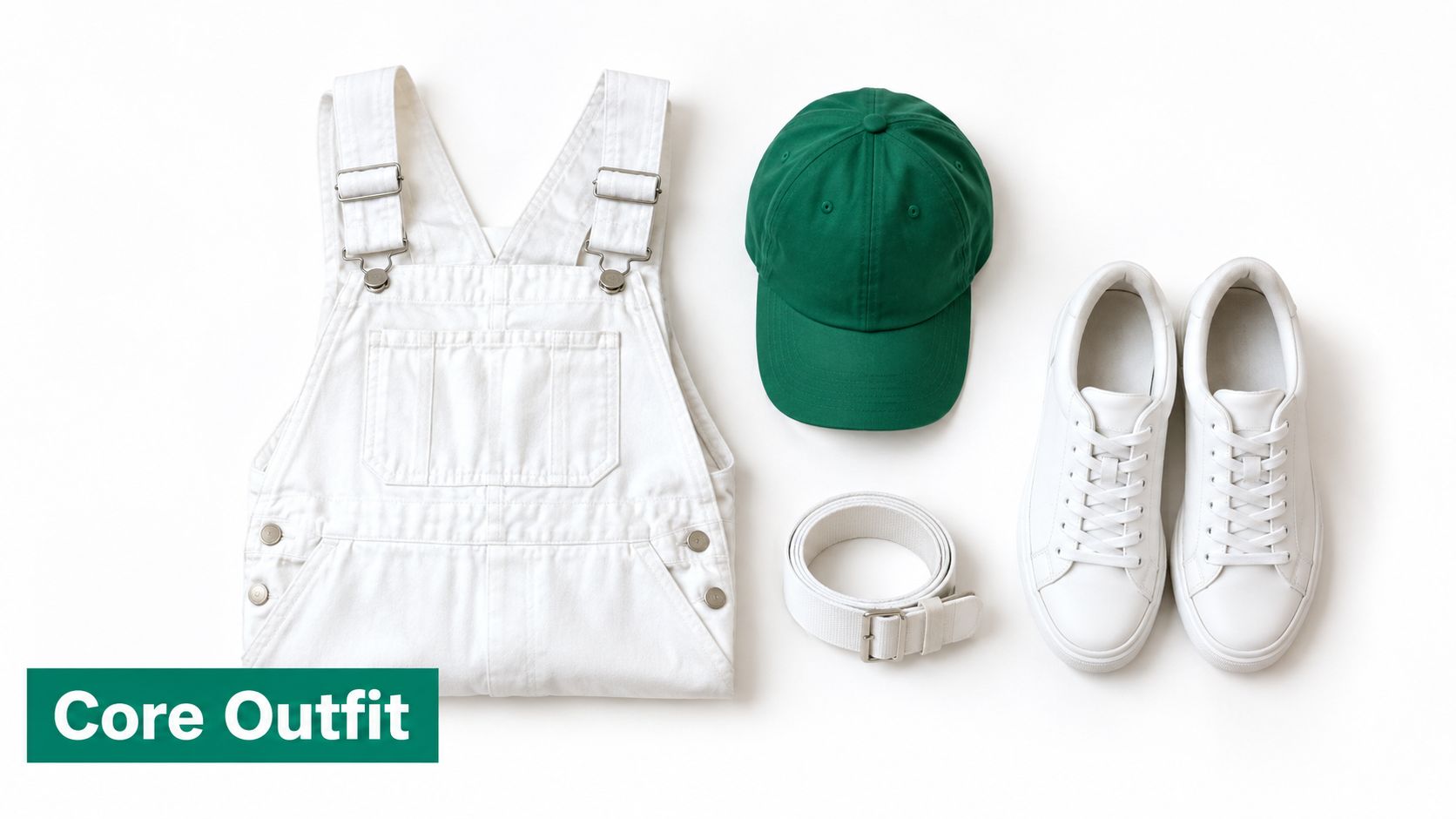
Start with the white base
Choose a full coverall when the event calls for a complete caddie character or a consistent family photo. It gives the outfit a continuous silhouette and leaves room for a visible name or number. A bib-style option layers over regular clothing, which can be easier for younger children, warm rooms, or guests who want to take off the themed layer after pictures.
Think about what the wearer will do, not only how the outfit will look on a hanger. A bib is often more adaptable for a short indoor party; a full jumpsuit makes a stronger statement when the costume itself is the point. Either way, keep the base predominantly white so the green cap has a clear role.
Choose the cap to suit the group
The classic green caddie-style cap is the simplest match. A place-inspired or family-themed hat can add personality while retaining the same color anchor. Options such as Scottsdale, 30A Beach, SEC City, and Dad or Mom hats can coordinate a family without requiring everyone to wear identical headwear.
A useful rule: choose one main hat design per group, then let names, numbers, or small patches distinguish individual outfits. If everyone's cap, bib, and uniform all carry different graphics, the group loses its shared visual thread.
Add only what improves the story
Personalization should come after the base and cap. Start with a name or number, then decide whether a patch contributes something meaningful. A hat, scorecard, or putter-style accessory can supply one extra golf cue, but layering several novelty items usually makes the outfit busier rather than more authentic.
Practical rule: If the white base and green cap don't read clearly from across the room, remove an accessory before adding another.
For guests assembling outfits from existing clothes, a simple white layer and green cap may be enough. A curated wardrobe can also help with a family shoot or event where coordinated pieces need to be tried together; check the client closet selection for possible outfit components before purchasing anything new.
Sizing for Kids, Adults, and Tall Bodies
A costume that fits poorly can look untidy in photographs and become uncomfortable during the event. The safest approach is to measure the wearer and check the garment's own size chart instead of guessing from everyday clothing. For coveralls, chest, waist, torso length, and inseam all matter because a garment can fit across the shoulders yet still pull at the seat or drag at the hem.
Measure before choosing a size
Have the wearer stand naturally in the clothes they'll wear underneath the costume. Record the chest, waist, torso length, and inseam, then compare those measurements with the manufacturer's chart. Adult caddie uniforms are available from XS through 3XL, with selected LONG variations for heights over 5'11"; children's options range from 0–3 months through 11–12 years.
| Category | Size Range | Notes |
|---|---|---|
| Adult | XS–3XL | Selected LONG variations are available for heights over 5'11". |
| Kids | 0–3 months through 11–12 years | Measure the child and check the specific garment chart. |
Sizing up substantially to leave room to grow often backfires. Loose sleeves can catch, and long hems can drag or create a trip risk. For a one-day costume, a secure fit that allows movement is more useful than extra fabric the wearer can't manage.
Test movement, not just standing fit
For a child's outfit, check that the garment stays secure while the child walks, sits, climbs stairs, and reaches. Shorten or remove anything that drags, catches, blocks vision, or swings into another person's path. Inspect seams, closures, patches, and decorative attachments before the event, and keep small detachable pieces away from infants and toddlers.
The safety point isn't limited to golf parties. In the three years preceding 2022, U.S. emergency departments treated an estimated average of 3,200 Halloween-related injuries annually, with costumes and related risks representing approximately 20% of those injuries. Those figures are about Halloween, not Masters parties, but they offer a relevant reminder to treat costumes as clothing people need to move in. (Costume-related injury and safety guidance)
Make comfort part of the fit
An outfit for hours of walking needs more mobility and fewer fussy details than one worn briefly indoors for a photo. Sensory-sensitive wearers may do better with soft underlayers, a cap-free option, and removable or fabric-backed patches instead of stiff collars or scratchy decorations. Keep footwear visible and secure, and make sure the garment doesn't restrict the shoulders, knees, or seat.
Personalizing with Names, Numbers, and Patches
A caddie costume reads in a photo when the personal mark is deliberate. A readable name, a single number, or one small patch can turn plain white coveralls into a recognizable uniform, while a scatter of decorations makes the outfit look like craft day. Treat personalization as a system: one identifier leads, everything else supports it.
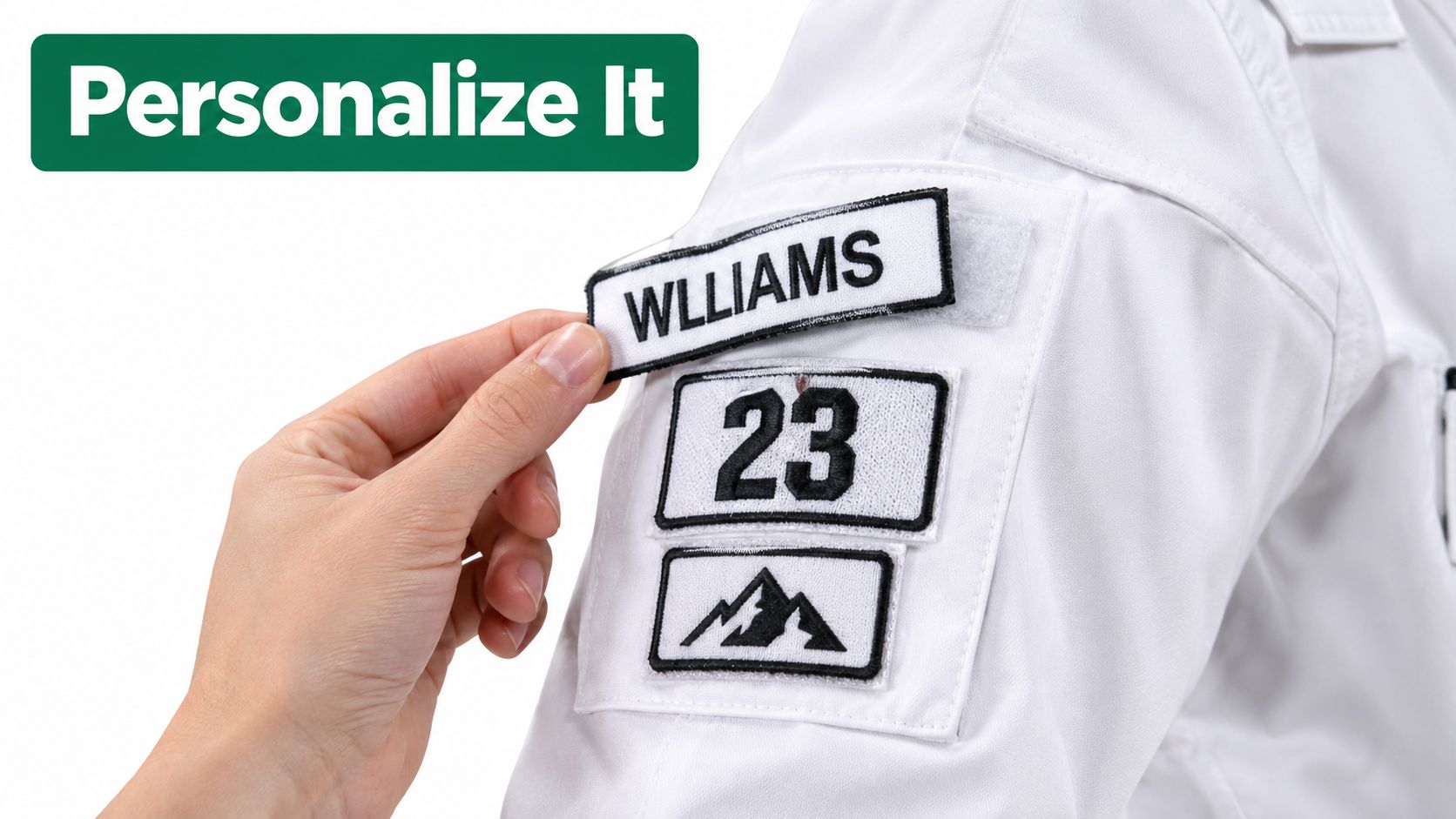
Place details where a camera can see them
Before attaching anything, have the wearer stand naturally and check where the fabric folds. A nameplate should sit flat and face outward. A number should stay clear of seams, straps, zippers, and the spot where a cap brim or collar throws shadow in close-ups. If people will pose shoulder to shoulder, vary the side slightly so the details do not stack into one repeated visual block.
Choose one primary identifier, such as a name or number. Add a small patch only if it helps the person's character or connects the outfit to the event. Multiple large patches can crowd a white uniform and compete with the green cap, particularly in close-up photographs.
Keep the system flexible
Because the base uniform stays constant, removable details are where a family can experiment: swap a number for a birthday age, rotate a themed patch for a holiday, or reuse the same white layer for a different wearer. Velcro nameplates and peel-back numbers are practical for kids' costumes because sizing, spelling, and enthusiasm all change faster than the garment does.
A custom name, number, or logo can create that look; personalized golf apparel is one place to compare lettering, patch, and placement options. Permanent marks work best when the costume has one owner and one job, such as a host who wants the same “caddie” name every year.
For a group, keep placement consistent and let the content vary. Same name zone, same number zone, different identities. The look stays unified, but no one feels interchangeable.
Coordinating Family and Group Looks
A coordinated family doesn't need to wear matching coveralls from head to toe. A stronger group look comes from repeating a few visual cues while giving each person a version suited to their age, comfort, and role. One adult might wear a full white coverall, another a bib over everyday clothes, and children smaller versions with the same green cap color.
The tournament offers a cultural reference for family participation: during the Wednesday Par-3 Contest, players' partners and children have been required to wear jumpsuits. For a party, that makes a coordinated family costume feel connected to the caddie tradition rather than like a collection of unrelated golf outfits.
Give the group a shared visual rule
Set a simple palette before anyone shops or assembles an outfit. Keep white and green as the foundation, then let each person add one personal detail. Matching hats, consistently placed nameplates, or a shared number scheme can tie the group together without requiring the same cut of uniform.
A practical family arrangement could look like this:
- Adults who want a full costume: Wear white coveralls with green caps and individual names or numbers.
- Guests who prefer a lighter layer: Choose a white bib over comfortable clothes, keeping the same hat color.
- Young children: Use a secure, easy-to-move-in outfit with minimal detachable pieces.
- A host or team lead: Add a small shared patch or distinct number, not a second competing color scheme.
The combinations can vary, but the shared cues should remain visible. If one person wears a green hat, another has only a bright patterned shirt, and a third carries several unrelated props, the group may look festive but won't read as a coordinated caddie team.
Assign roles without forcing a uniform
Names and numbers give family members a playful way to claim a role. Children can choose a number or patch, while adults can use names or hats to differentiate themselves. The design should still accommodate different bodies and preferences: a guest who dislikes coveralls can wear a bib, and someone who doesn't tolerate hats can keep the green cue in another removable accessory.
For photos, consider height and placement as well as clothing. Put the clearest white-and-green combinations near the center, and avoid hiding nameplates behind crossed arms or golf props. Before the event, have everyone stand, sit, and walk in their outfit so the family picture doesn't come at the cost of comfort.
The best group costume is consistent at a glance and individual up close. Repeating the same palette and one shared accessory achieves that balance more reliably than making every person wear identical pieces.
Styling Tips for Photos and Events
A photo-ready outfit needs controlled color, visible details, and clothing that suits the room. For a green jacket or outer layer, a precise reference helps: the tournament's established jacket color is Pantone 342, and the canonical garment is a lightweight, single-breasted, three-button jacket with a single vent. Modern versions use tropical-weight wool or a wool-polyester blend. (The history and design of the Masters green jacket)
That jacket is an optional styling reference, not a reason to replace the caddie outfit's white base. Green shades that look similar in a shop can photograph differently. Compare the cap, jacket, or outer layer in daylight, then check the full outfit under the event's lighting before the group arrives.
Control color and accessories
Keep secondary colors to white, cream, tan, or muted gold. Gold trim can add contrast, but large metallic graphics tend to look more like general sportswear than a restrained Masters-inspired costume. Add one golf cue, such as a cap, scorecard, putter-style accessory, or flag motif. Several logos and props at once can obscure the outfit's main silhouette.
Fabric choice affects how long the costume stays comfortable. For warm indoor or summer events, lightweight, breathable materials work better than a thick layer that traps heat. Stable, non-spiked shoes are more suitable for ordinary party floors, and any accessory that could catch or trip its wearer should come off before games or active outdoor play.
A host arranging photos may also want a simple place for guests to pose. A party photo booth setup can give the group a dedicated spot for pictures, while a small set of green-and-white props keeps the backdrop from competing with the outfits. For hosts still choosing activities, these golf party ideas for adults can help match the event's tone to the costume.
Quick answers for special situations
- What works for a wheelchair user? Choose a bib or jacket-style layer that stays visible while seated and doesn't bunch at the waist or interfere with wheels. Keep accessories secured and within reach.
- What helps a sensory-sensitive child? Use a familiar soft layer underneath, skip stiff collars, and make patches or hats optional. Let the child try the complete outfit before the event.
- What if the weather may change? Add removable layers over the costume and choose comfortable, weather-appropriate footwear. Keep the caddie cues visible when the outer layer is on.
Before the party, check the outfit standing, seated, and in a test photo. If the name, number, or green accent disappears in the picture, adjust its placement. The finished look should be instantly recognizable without making the wearer adjust it all evening.
Caddie Uniform offers personalized adult and children's caddie coveralls and bibs, along with hats, removable nameplates, numbers, and patches for building a coordinated Masters-inspired look. Choose the pieces that fit the event and wearer, then visit Caddie Uniform to explore the available options.


