


The costume box is open on the kitchen floor, a toddler is wearing a bib backwards, and an older child is already complaining that the coveralls look too babyish. Meanwhile, the phone has too many shopping tabs open, the half-painted “Hole One” sign is drying beside the cake order, and nobody knows whether the putting set includes soft balls.
After three golf-themed birthdays, the lesson is clear: golf birthday party supplies need to be planned around the children attending, not around a perfect product bundle. Before any order is placed, parents should know which uniform style suits each age, which items are worth buying, what can be made at home, which supplies need to stay away from toddlers, and how the setup will work from guest arrival through cleanup. A useful starting point is this guide to a golf-themed first birthday, but the final plan should always match the youngest guest and the actual venue.
Planning Your Golf Birthday Party Around Real Kids
Golf parties look simple in photographs because the finished setup hides the decisions underneath. The children may appear in matching bibs beside a neat putting green, but someone had to check every size, remove unsafe pieces, label the favors, and decide whether the “golf equipment” was for play or decoration.
The cleanest approach starts with the guest list. Record each child's age, approximate size, mobility needs, and whether the child will take part in putting, crafts, or dress-up. Infants and crawlers need a very different environment from older children who can follow game instructions and carry lightweight props safely.
Practical rule: The youngest guest sets the safety standard for shared supplies, even if most attendees are older.
Build the supply plan in the right order
- List the children first. Include siblings, cousins, and adults who may join photographs or activities. Mixed-age parties often fail when the host buys one uniform style for everyone.
- Divide the room or yard into zones. Keep food, active play, and decorations separate. This makes it easier to keep loose items away from children who may mouth objects and gives adults a clear view of the activity area.
- Choose the outfit lane. Infants and crawlers generally need a soft, simple bib or a photo-only outfit. Toddlers need secure closures and minimal detachable decoration. Older children can handle more structured uniforms, hats, and supervised activity props.
- Inspect everything before setup. Check seams, snaps, straps, patches, hat brims, foam pieces, and packaging remnants. Broken balloons and detached parts should leave the party area immediately.
- Prepare a kickoff station. Place labeled outfits, name patches, activity supplies, and favor bags where an adult can distribute them one child at a time. A pile of identical items creates confusion and makes fit problems harder to catch.
The host shouldn't try to make every item look authentic. A large paper flag, fabric banner, and reusable turf-style mat can create the theme without putting small golf objects within reach of a crawler. The best party feels organized to guests because the difficult choices happened before the door opened.
Why Golf Is a Smart Birthday Theme in 2026
Golf works because it isn't locked to one age group. A preschooler can crawl across a soft “green,” a school-age child can play a putting game, and a tween can wear a cleaner cap-and-bib combination without feeling dressed like a toddler. Adults can join photographs without turning the party into a formal sporting event.
The audience is also broader than many parents assume. The R&A's 2024 Global Golf Participation Report counted 108 million adults and juniors playing golf in some form across affiliated markets outside the United States and Mexico. That total included 64.1 million adults and 43.9 million juniors, while 80% of junior golfers took part through alternatives such as driving ranges, indoor golf, adventure golf, or other nontraditional formats.
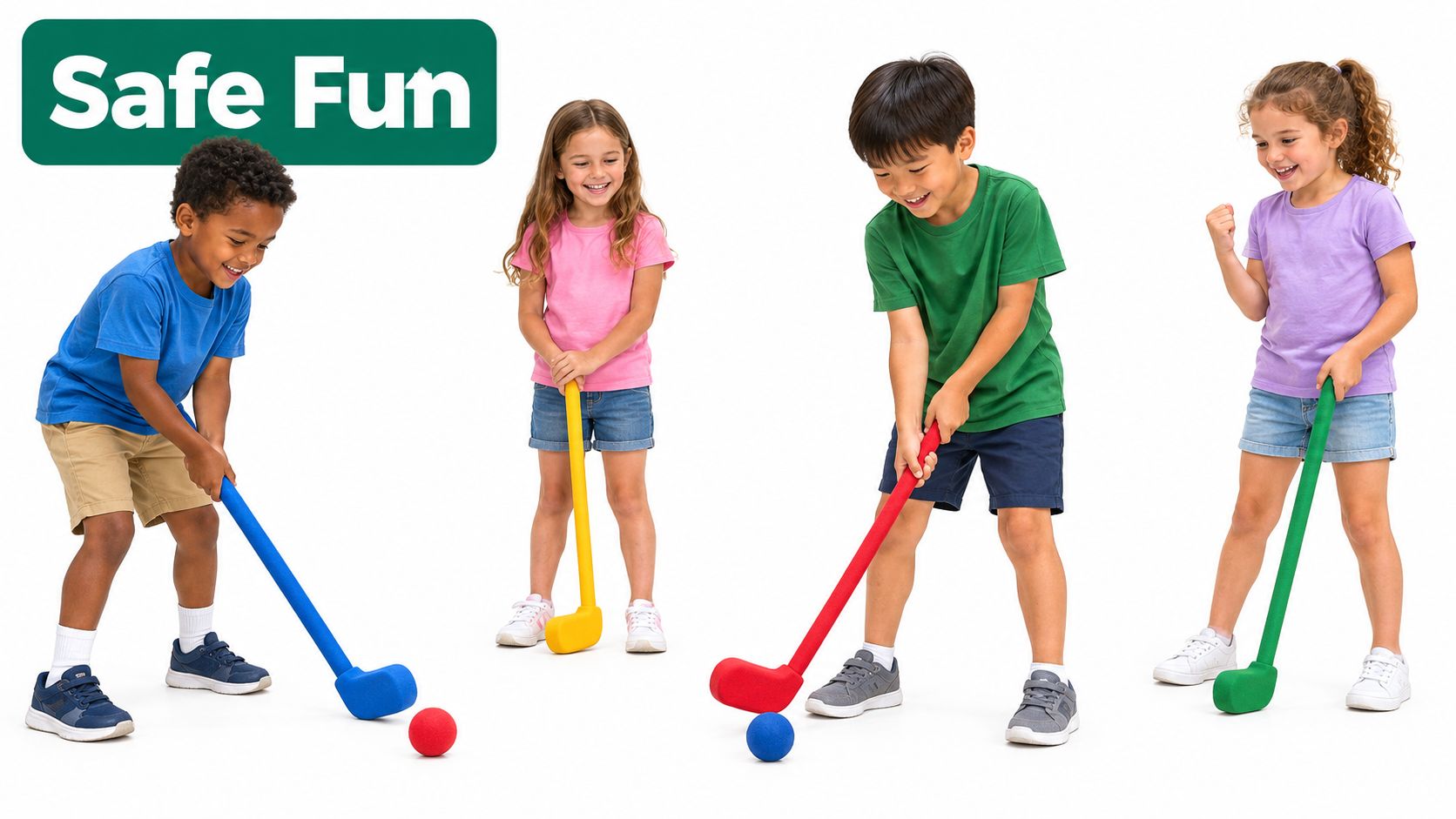
That matters for party planning. Children don't need course experience to enjoy a golf theme. A hat, bib, flag, soft club, or photo prop can support imaginative play just as easily as a putting game.
Treat supplies as five connected layers
- Uniforms: Caddie coveralls, bibs, caps, visors, and removable patches create the visual identity. One personalized outfit for the birthday child may be enough, while siblings can use coordinated but simpler pieces.
- Decor: Turf runners, flag pins, table signs, pennants, and a welcome board make the space read as a course without filling every surface with plastic decorations.
- Activity gear: Putting mats, oversized soft balls, and lightweight clubs give children something to do. These should be selected by age, not merely by appearance.
- Favors: Bag tags, ball markers, keychains, or reusable containers can work for older children, but small components need to stay away from toddlers.
- Tableware: Plates, cups, napkins, labels, and food signs carry the theme through the snack area. They also provide a safer visual effect than loose decorative pieces scattered across a table.
A layered kit prevents the common mistake of spending heavily on decorations while forgetting the items that keep children occupied. For a larger event or a workplace family day, parents and organizers may also find ideas in this resource about mobile mini golf for corporate events, particularly when the activity itself needs to serve a wide age range.
Sizing and Personalization for Every Age at the Party
Age labels are a starting point, not a fit decision. Children of the same age can have noticeably different stature, chest, waist, hip, and sitting proportions, so coordinated golf outfits should be ordered from measurements whenever possible.
The CDC's anthropometric references treat body dimensions such as height, weight, chest girth, waist girth, hip girth, and sitting-related measurements as relevant to clothing and equipment design. Its historical probability sample included 7,417 U.S. children ages 6 to 11, which illustrates why an age-only label can't describe every child's shape. The CDC anthropometric reference supports a measurement-led process rather than a guess based on the birthday invitation.
Measure before choosing the uniform
For each child who will wear a coordinated outfit, record:
- Stature, measured without shoes.
- Chest, waist, and hip measurements, taken at the widest relevant points.
- Sitting and movement needs, especially for children who will crawl, bend, sit on the floor, or use a putting station.
- Head measurement, if the supplier provides a hat chart.
- Measurement date, because children can grow quickly.
Use centimeters for a consistent record, then compare every measurement with the supplier's chart. Select the garment based on the largest controlling measurement, while leaving enough ease for movement. An outfit shouldn't be so large that hems, straps, or bib edges become trip hazards.
| Age Band | Uniform Style | Key Measurement | Personalization |
|---|---|---|---|
| Infants and crawlers | Soft bib or photo-only layer | Chest, waist, and movement clearance | Removable name element secured away from reach |
| Toddlers | Simple bib with secure closure | Stature, chest, waist, and hip | Larger flat name panel or number |
| School-age children | Coveralls, bib, or vest | Stature and chest, checked against the chart | Name, number, or team-color patch |
| Teens and adults | Vest, bib, or structured uniform | Chest, waist, hip, and length | Embroidered name or coordinated logo |
Personalization works best when it supports reuse. Name patches, numbers, a bib-chest name, ball markers, and birthday-child flag colors can create a finished look without requiring every guest to receive the same garment. Parents comparing options can review personalized golf apparel before ordering.
The avoidable mistakes are familiar: choosing coveralls by age alone, ordering adult hats for children, and submitting names before a second adult checks the spelling. A sober final review of names, sizes, closures, and delivery dates prevents an expensive party-week scramble.
Buy, DIY, or Skip Choosing Each Supply Category
Not every golf detail deserves a purchase. The sensible question is whether a supply affects fit, safety, activity, or photographs. If it does none of those things, it probably belongs on the skip list.
The table below uses qualitative budget and timing labels because party prices vary by material, personalization, shipping, and quantity. A parent shopping close to the event should treat lead time as seriously as cost. Custom work can be the wrong choice when the guest list is still changing.
| Category | Buy ($) | DIY ($) | Rent ($) | Pick For Most Parties |
|---|---|---|---|---|
| Caddie coveralls | Medium to high | Medium | Medium | Buy for the birthday child or a coordinated group |
| Bibs | Low to medium | Low | Low to medium | Buy when quick sizing and easy distribution matter |
| Visors and caps | Low to medium | Low | Low | Buy a small coordinated set, skip for very young guests |
| Name patches | Medium | Low to medium | Not practical | Buy or order removable patches |
| Decorations | Medium | Low | Medium | DIY signs and banners, buy reusable anchor pieces |
| Favors | Low to medium | Low | Not practical | DIY bags, use age-appropriate contents |
| Mini-golf kits | Medium | Low to medium | Medium | Buy soft activity equipment or rent a supervised setup |
Where the budget should go
A ready-made bib is usually the sensible choice when a parent needs a quick, consistent outfit for several children. A printable sign, paper pennant, or homemade scorecard is a better DIY project because minor imperfections add charm and don't affect fit or safety.
Rental makes sense for a venue with existing activity equipment or for a mixed-age gathering where one supervised station is more useful than several small sets. It also reduces storage after the party. A gear hauler and luxury bench can be a useful planning reference when the event needs organized seating and transport for shared equipment, though it isn't a substitute for age-appropriate play gear.
DIY almost always loses for printed name patches, embroidered details, and inflatable balls used at the putting station. The finish, durability, and timing rarely justify a last-minute home project. DIY wins easily for yard signs, favor bags, and scorecards, especially when the birthday child can help decorate them.
The accessories should serve the plan, not expand it. A focused golf accessories collection can help a host fill a genuine gap, but no party needs every available hat, patch, marker, and novelty item.
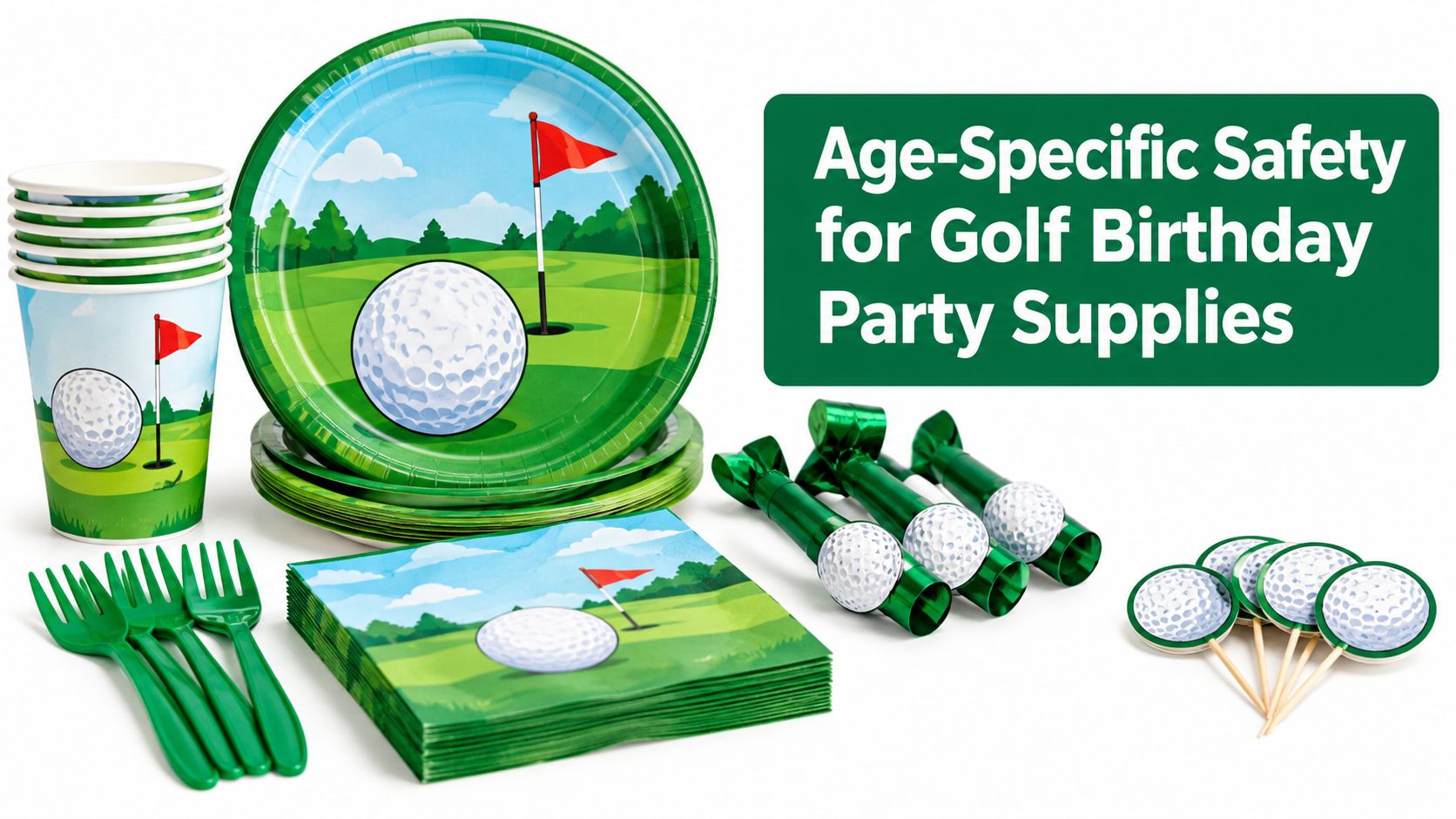
Age-Specific Safety for Golf Birthday Party Supplies
A golf party needs an age-by-age safety specification, not just a themed shopping list. Standard golf items can become choking, ingestion, collision, or trip hazards when toddlers share a room with older children.
The U.S. Consumer Product Safety Commission identifies balloons as a major suffocation hazard. Children younger than eight shouldn't handle uninflated or broken balloons without supervision, and fragments should be discarded as soon as they appear. Historical CPSC data cited in its balloon safety guidance found that approximately 40% of reported child choking fatalities from 1990 to 2010 involved balloons.
Use a separate specification for each group
- Infants and crawlers: Use soft bibs, fabric banners, large signs, and soft flooring. Keep loose tees, hard balls, detachable patches, favor pieces, and balloon fragments out of reach. A stiff-brim visor shouldn't be treated as a safe toy for a crawler because straps, edges, and detached parts create risks.
- Toddlers: Replace standard tees with oversized foam alternatives and hard balls with large soft balls. Use lightweight clubs only with direct adult supervision. Choose snap or securely fastened closures instead of loose ties, and keep the putting cup fitted with a soft insert.
- Early elementary children: Foam equipment remains the safer default for indoor play. A visor can be appropriate when it fits securely and doesn't obstruct vision, but it should be checked before use. Separate the activity lane from younger children and stop play if a club becomes a swinging collision risk.
- Mixed-age groups: Create a toddler-free equipment zone or schedule older-child play in turns. Store small favors and removable patches behind an adult-controlled table. An adult should actively supervise the putting station rather than watching from across the room.
The safest decoration is often a reusable paper, fabric, or large-format item. Parents should also inspect the floor for loose edges, cords, and objects that can be swallowed. The putting green cup deserves special attention, since a rigid opening can create a fall or impact concern when toddlers are present.
Printable fridge swap list
- Real tees, swap for oversized soft alternatives.
- Hard golf balls, swap for large foam or plush-style balls.
- Loose patches, swap for securely fastened or removable pieces held by an adult.
- Tie bibs, swap for secure closures.
- Balloon décor, swap for paper pennants or fabric banners.
- Small favors, store away from toddlers until departure.
- Rigid putting cup, use a soft insert when toddlers attend.
- Broken or detached items, remove immediately.
- Every activity, assign an active adult supervisor.
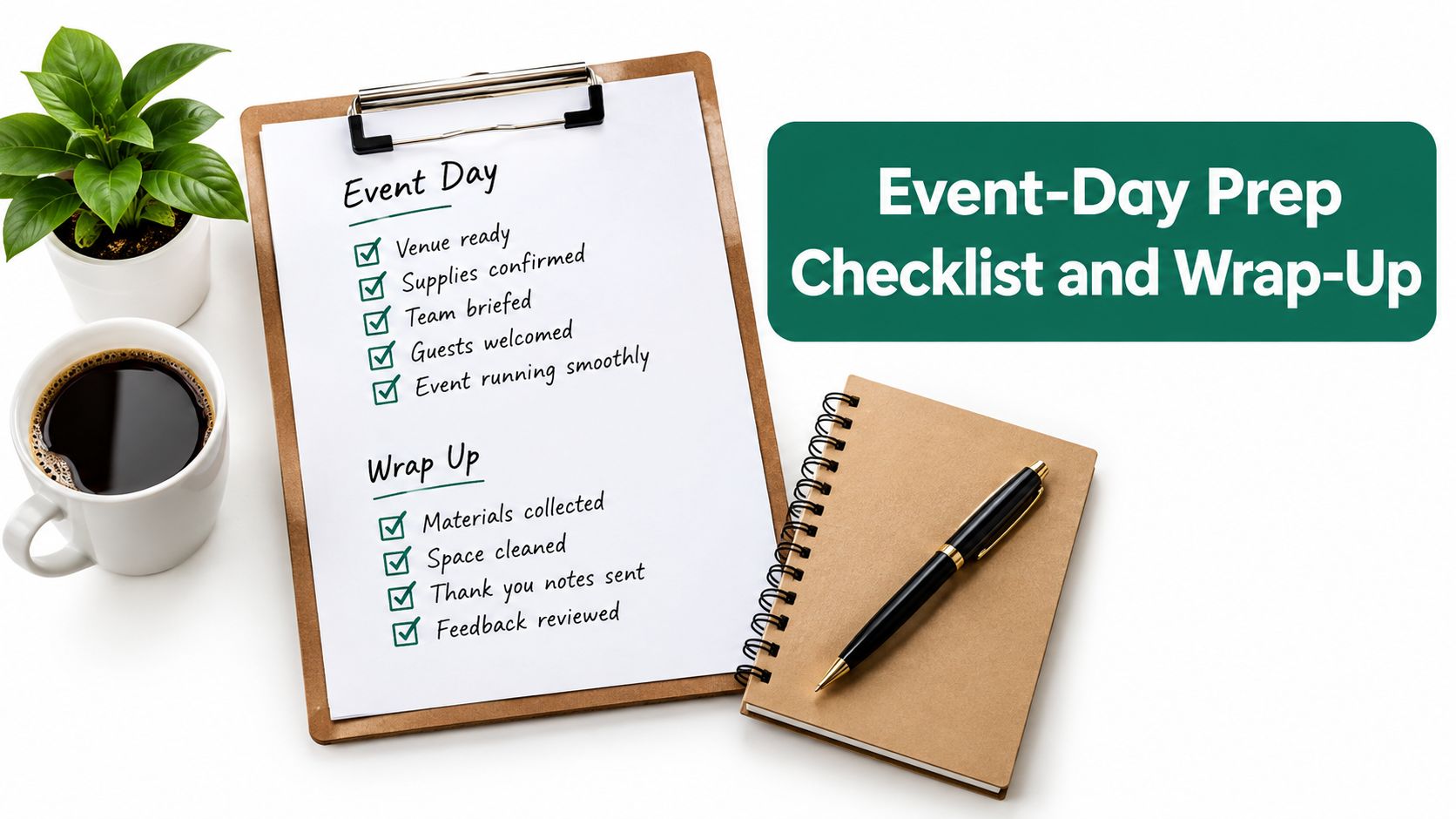
Event-Day Prep Checklist and Wrap-Up
Two hours before guests arrive, the host should stop shopping and start staging. Inflate or lay out the putting surface, place each uniform beside the correct name label, and set the favor station away from the active play area. This is the moment to notice that one bib is missing a snap or one hat doesn't fit, while there is still time to change the plan.
Forty-five minutes before arrival, fill water bottles, prepare one activity kit per child, and check that the photo backdrop and welcome sign can be seen from the entrance. Food should stay in its own zone. The adult supervising play should know where the spare soft balls, wipes, trash bag, and first-aid supplies are stored.
Run the party by supply station
At arrival, hand each child the correct bib or hat by name instead of allowing children to pull from a pile. The personalization then serves a practical purpose, and an adult can catch a poor fit before the child starts running.
During the party, rotate children between the putting station, craft table, and snack area. No single supply should become the only entertainment. Older children can take turns with the supervised activity gear, while younger children use the clear floor space and larger soft props.
A separate collection of 7 free party planning checklists can help hosts cross-check general tasks, but the golf-specific list still needs age, fit, and equipment checks.
Finish with the same discipline
At pickup, place favors in labeled bags and keep unclaimed patches with the adult rather than leaving them on the floor. Discard anything that broke, detached, or became a choking hazard during play. Don't put a questionable item back into the storage box for next year.
After cleanup, divide supplies into three groups: reuse, repair, and skip. Washable bibs, fabric banners, signs, and soft equipment usually deserve storage. Damaged decorations and novelty pieces that created confusion should stay out of the next plan. The strongest golf birthday party isn't the one with the most supplies. It's the one where every item has a job and every child can take part safely.
Caddie Uniform offers personalized children's and adult caddie uniforms, bibs, hats, patches, and golf accessories that can support the age-based outfit plan described above. Parents can review the available options and sizing guidance by visiting Caddie Uniform before ordering the birthday child's outfit or coordinating a group look.


