


Can a toddler coverall look perfect in a photograph but still be the wrong outfit for an ordinary day? Yes, especially when the child can't reach the toilet quickly, the crotch pulls during play, or a diaper change requires removing the whole garment.
Toddler coveralls need to work as clothing before they work as a costume. A useful choice balances body proportions, safe closures, washable fabric, and bathroom access. Names, patches, and coordinated accessories come after those practical checks.
Toddler Coverall Sizes and How to Measure
| Size | Typical age |
|---|---|
| 12M | Baby sizing; confirm the brand's age guidance |
| 18M | Baby-to-toddler sizing; confirm the brand's age guidance |
| 2T | Toddler sizing; match the child's measurements |
| 3T | Toddler sizing; match the child's measurements |
| 4T | Toddler sizing; match the child's measurements |
These common US size labels are starting points, not standardized body measurements. The brand's own chart takes priority, particularly when its height guidance conflicts with the age printed on a label. A universal height-and-weight table can create false confidence because coverall cuts differ.
A child's waist may fit comfortably while the shoulder-to-crotch length is already too short. Diaper bulk, torso length, and leg proportions all affect a one-piece garment, so age alone can't settle the choice.
Measure before choosing a label
A flexible measuring tape and a note of the child's usual clothing layers make the process more useful.
- Standing height comes first. With shoes removed, the child stands against a wall while an adult marks the top of the head and measures to the floor.
- Torso length needs separate attention. An adult measures from the top of the shoulder down to the crotch line, then checks whether the seller uses the same measurement method.
- Inseam helps identify proportion problems. The measurement runs from the crotch along the inside leg to the intended hem position. Comparing it with a well-fitting garment can help when a child won't stand still.
- Age remains a backup. It helps locate a likely size category, but shouldn't override the child's measurements.
For help interpreting clothing labels, ClothME's kids clothing size guide offers a useful companion resource. Before selecting a caddie-style garment, parents can compare their notes with the children's sizing page.
Allow growth without losing mobility
Parents favored size-adaptive toddler garments, particularly adjustments for vertical growth, in a peer-reviewed study of toddler garment design. That supports looking for useful adjustment rather than buying an oversized garment.
The fitting check should include the diaper and any intended sweater. There should be room at the hips and crotch without a low-hanging seat, and the shoulders should sit flat rather than pulling downward.
Fit rule: Growth room is useful only while the child can move comfortably in the garment today.
During a try-on, the child should squat, crawl, and sit on the floor. The crotch shouldn't bind or bunch heavily, the legs shouldn't pull sharply upward, and cuffs shouldn't drag under the feet. If extra torso room produces excessively long legs, a different cut may work better than a larger size.
Closures and Safety Features to Check First
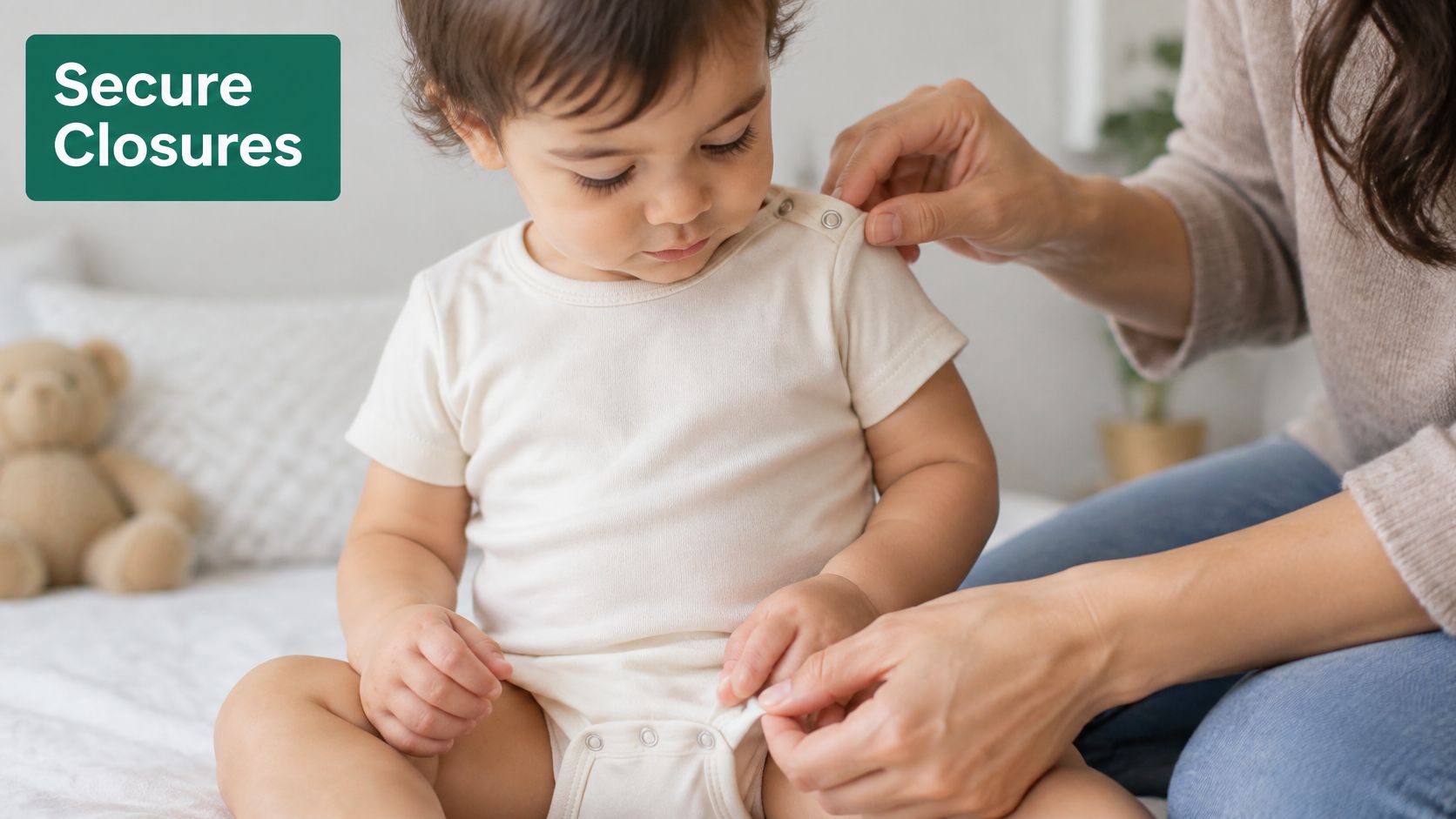
A loose cord near the neck can cause strangulation if it catches on equipment. Because a coverall connects the upper and lower body, parents should inspect every adjustment point rather than treating the waist, hood, and cuffs as separate details.
The US Consumer Product Safety Commission's drawstring guidance identifies hood and neck drawstrings on children's upper outerwear in sizes 2T through 12 as a hazard; waist and bottom drawstrings in sizes 2T through 16 must extend no more than 3 inches (75 mm) outside the channel when fully expanded, with continuous cords secured by bar tacks and no toggles, knots, or similar attachments on free ends.
Closure types and US-market safety notes
The table combines practical shopping checks with the outerwear drawstring restrictions described above. It isn't a substitute for a manufacturer's compliance assessment.
| Closure | Best use | US-market check |
|---|---|---|
| Front zipper with fabric guard | Daily wear and quick dressing | Pull lies flat; no dangling cord pull |
| Snaps | Crotch access for diaper changes | Securely attached, with no loose components |
| Hook-and-loop | Adjustable fit during growth | Exposed edges don't snag surrounding fabric |
| Elastic | Waist and cuffs for sitting and crawling | Recovers its shape after washing |
| Waist or hem cord | Waist adjustment when compliant | Meets the exposed-length restriction; no toggles or knots |
| Hood or neck drawstring | None for covered children's outerwear | Absent from garments within the restricted size range |
Inspect the finished garment
Parents can open and close each fastener while feeling the inside surface. A zipper guard should separate the teeth from skin, snaps shouldn't rotate loosely in the fabric, and hook-and-loop backing shouldn't leave a scratchy edge against the body.
- Check the neckline. Decorative ties deserve the same scrutiny as functional cords.
- Examine attachment points. Loose zipper pulls, toggles, and small detachable decorations need attention before wear.
- Repeat the inspection after washing. Fabric movement can reveal cord length or loosen attachments that looked secure when new.
A neat-looking trim sample doesn't prove that the finished coverall is safe. Parents should judge the actual garment, while manufacturers remain responsible for determining which requirements apply to its intended use.
Choosing Fabric That Survives Daily Wear
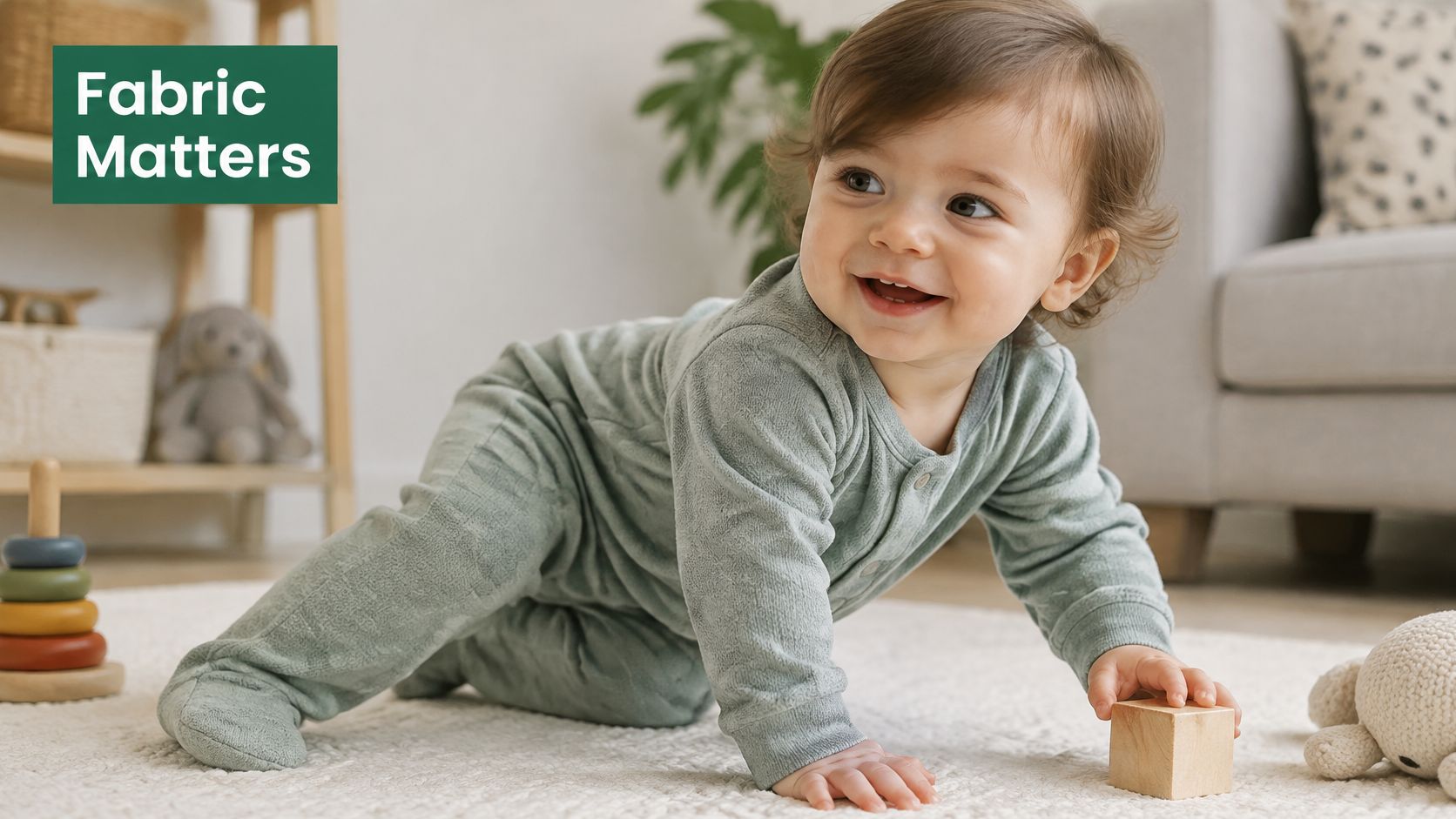
A coverall surrounds much of the body, so the inside finish matters as much as the outer appearance. Parents should feel the seams, pocket backing, and zipper area, not just stroke the fabric on the chest.
Cotton represented approximately 36.7% of toddler-wear market share in 2025, according to Global Market Insights. That broader clothing figure doesn't establish the best material for every coverall, but cotton and cotton blends are sensible starting points for familiar, comfortable everyday clothing.
Match the fabric to the activity
Cotton or cotton blends suit everyday play when the garment feels soft and allows movement. Parents should check the care instructions for shrinkage considerations rather than assuming every cotton garment behaves alike.
Polyester blends can offer convenient washing and drying, but construction still matters. A stiff seam or heavy backing can make an otherwise lightweight coverall uncomfortable.
Knits and fleece provide different benefits: knit describes a fabric structure, while fleece describes a raised surface. Neither term alone establishes warmth, durability, or safety. Smooth woven fabrics and tightly constructed knits are generally easier to inspect than heavily fuzzy surfaces.
Separate comfort from flammability compliance
Under 16 C.F.R. Part 1610, the CPSC apparel and household textiles guide describes Class 1 fabrics as normally flammable and acceptable for apparel, Class 2 raised-surface fabrics as intermediate, and Class 3 fabrics as dangerously rapid-burning and prohibited for clothing.
Parents don't need to perform flame tests at home.
- Review product information. A missing compliance statement isn't proof of failure, but a soft fabric description isn't proof of compliance either.
- Consider the complete garment. Manufacturers should assess printed areas, patches, finishes, and construction changes.
- Keep daywear separate from sleepwear. A costume or daytime coverall shouldn't be treated as pajamas.
For routine care, washing inside out and using mild detergent can help protect surfaces. The care label should govern temperature and drying, with unnecessary high heat avoided.
Personalizing Names, Numbers and Patches Safely
A name can help adults identify clothing at daycare, while a number or themed patch can coordinate an event outfit. The best personalization method depends on whether the garment needs frequent laundering, flexible reuse, or a permanent identity.
Sewn-on lettering offers a fixed finish, but its backing can feel rough inside the garment. Parents should check for puckering and loose thread ends, especially where lettering sits over the chest.
Heat-applied patches avoid some stitching but rely on a sound bond with the base fabric. Lifting corners can catch fingers, and a stiff patch can stop the fabric from bending naturally. Home application shouldn't involve temperatures beyond the garment's care instructions.
Permanent detail or reusable nameplate
Hook-and-loop nameplates can move between garments or make sibling reuse easier. The trade-off is removability: a patch that a toddler can peel away needs more scrutiny than a permanently secured detail.
The guide to custom removable name patches helps explain the format. Suitability still rests on the actual patch, its attachment, and the child's behavior.
A secure sewn name may be the simpler option for daily wear. A removable design can be more flexible for occasional supervised use, provided it doesn't become an accessible loose piece.
Check the decoration as well as the outfit
- Place lettering thoughtfully. Chest or back placement keeps decoration away from the face and neckline.
- Inspect every edge. Finished, stitched edges are preferable to raw edges that fray or lift.
- Feel the reverse side. Backing shouldn't scrape the skin or create a hard ridge.
- Recheck after laundering. Peeling, fraying, and weakened attachment are reasons to remove the garment from use until repaired.
Personalization shouldn't make a comfortable coverall stiff, scratchy, or easy to dismantle.
Added decoration also changes the finished garment, so a fabric's original properties shouldn't be assumed unchanged. If a child can pull a piece free and put it in the mouth, that piece shouldn't remain on toddler clothing.
When Coveralls Work for Potty Training and Diapers
Coveralls can keep an outfit coordinated while making toileting harder. The KidsHealth toilet-teaching guide recommends easily removed clothing and cautions against overalls and other difficult-to-remove designs during toilet training.
Bathroom independence matters more than the outfit's appearance. A child who recognizes the need to go may still struggle with a zipper, sleeves, and a shoulder section that must come off before sitting down.
Coverall suitability by stage and situation
| Situation | Coverall works? | Condition or better option |
|---|---|---|
| Diapered toddler, not yet toilet training | Yes | Front opening plus snap or zip crotch for changes |
| Toilet training, child undresses alone | Usually no | Two-piece set with an elastic waist |
| Short photo session or cake smash | Yes | Diaper change or bathroom stop before photographs |
| Full-day party with several bathroom trips | Limited | Two-piece outfit, or adult help and a bathroom plan |
| Frequent diaper changes at home | Yes | Crotch opening that avoids full removal |
A front zipper isn't automatically a bathroom solution. If it stops above the crotch, an adult may still need to remove the upper garment for access. Similarly, adjustable shoulder straps on bib-style overalls don't necessarily make them easy for a child to manage.
Rehearse the whole bathroom sequence
Parents can watch the child attempt removal before an event, including any layers underneath. The important question is whether the child can complete the sequence without struggling, not whether an adult can undo the fastener quickly.
For diaper changes, the opening should allow useful access without pulling fabric tightly across the child. A nominal crotch opening that barely spreads may be less convenient than its product description suggests.
A bathroom or diaper stop before dressing can simplify a short occasion, but it doesn't replace responding to the child's needs. For longer outings, a familiar spare outfit gives parents a practical exit plan if the coverall becomes inconvenient.
Styling Coveralls for Cake Smashes and Halloween
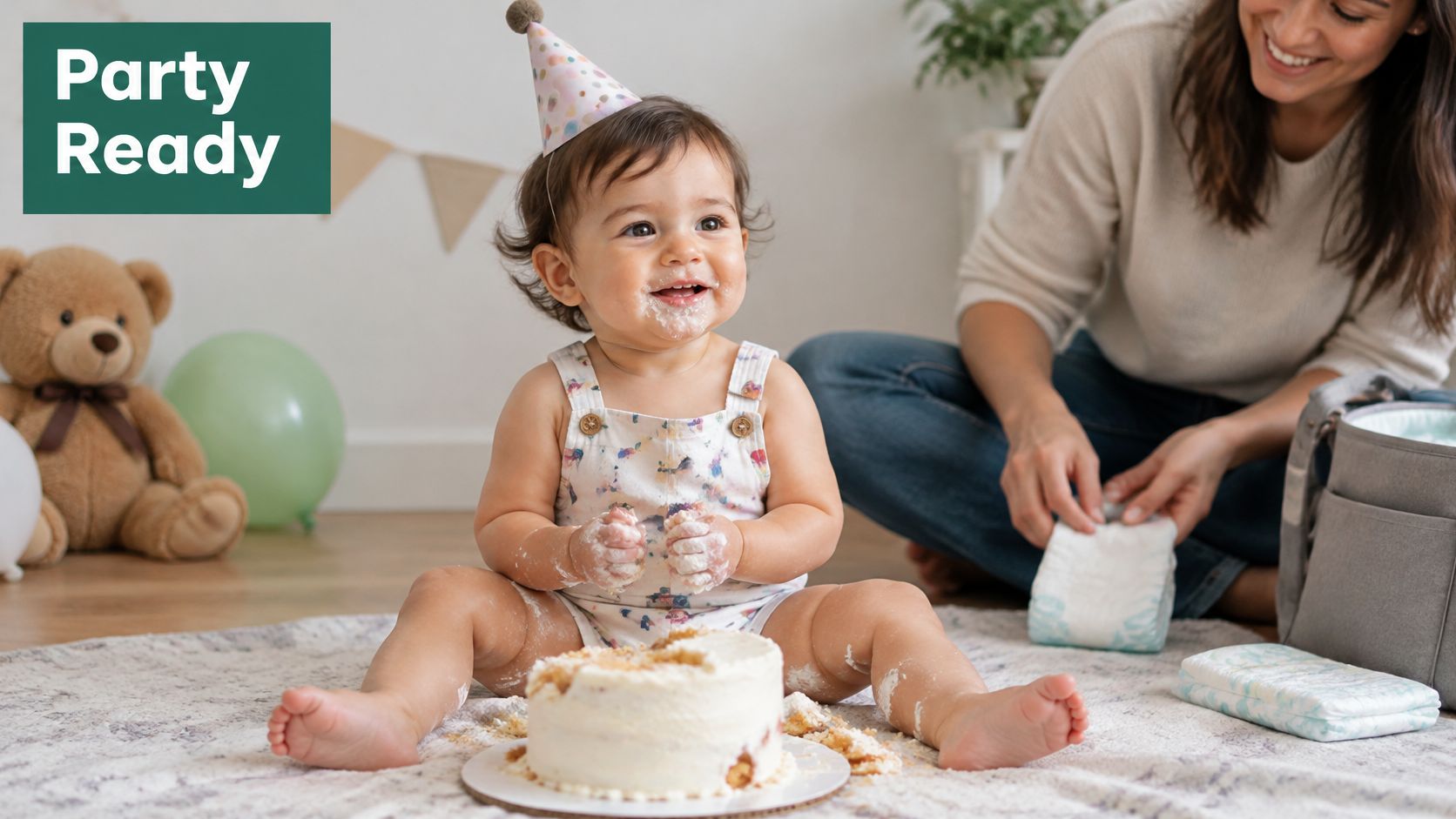
For a cake smash, the outfit needs to work while the child sits, reaches, and leans forward. A roomy-looking photograph isn't enough if the sleeves resist reaching or the legs pull when the child settles onto the floor.
A washable garment and a spare outfit make more sense than delicate decoration. The coverall can carry the theme while the cake, backdrop, and coordinated colors supply the visual detail.
A golf-themed birthday
Say a family chooses white coveralls with green accents for a golf-themed celebration. Keeping the hat and backdrop within that palette creates coordination without attaching extra objects to the child. The same look suits hole-in-one first birthdays, where the coverall does its work in photographs before the mess begins.
A practical sequence helps here. Dress the child, take the photographs, then change into simpler clothing for the rest of the party. If parents want more than one wear from the purchase, a size with modest growing room lets the same coverall return as everyday playwear once the event has passed.
Halloween and group photographs
Halloween runs on the child's schedule, not the costume's. Dressing a toddler right after a nap works better than asking for cooperation late in the evening, and a coverall worn for photographs can come off before a long stretch of walking or stroller time. The toddler golf-caddie Halloween costume guide covers the recognizable white-and-green theme in more detail.
For a short outing, a bib over familiar clothes may be enough. A full matching outfit gives group photographs a more uniform appearance, though comfort and easy access still come first. Caddie Uniform supplied uniforms for a Par 3 contest at a California country club, where all the club members' children wore its gear, and that coordinated approach translates to a family photograph without elaborate accessories.
- Choose a consistent accent color. Repetition creates a theme without extra trim.
- Use a well-fitting hat. A snug band avoids adding a dangling chin cord.
- Keep props separate. Pins, novelty objects, and loose appliqués don't belong near the mouth.
- Plan around naps and meals. The child's routine sets the timeline more reliably than the costume does.
Costume styling shouldn't relax the standards applied to ordinary clothing. Decorations still need secure attachment and appropriate material choices.
Choose the Coverall and Confirm Size Before You Order
Choose a garment that fits the child's current routine. Parents should decide whether the coverall will serve as regular playwear, an occasional coordinated outfit, or a short-event costume before paying for customization.
Run a final order check
- Check the closure layout against the child's stage. A toddler in diapers needs an opening a parent can reach quickly, while a child who uses the toilet alone needs one they can manage themselves.
- Look for loose parts in product photographs. Cords, dangling pulls, and detachable decorations shouldn't appear near the collar or within reach of the mouth.
- Review fabric and care information. Washability needs to suit the intended use, and fabric descriptions shouldn't substitute for safety information.
- Set the budget around realistic wear. Personalization may be worthwhile for repeated use or a meaningful event, but it doesn't compensate for poor fit.
A very low price should prompt closer inspection, but a high price doesn't prove that closures, fabric, or construction are suitable. Parents get more useful information from clear measurements and detailed photographs than from price alone.
Buying priority: The child's ability to use the garment comfortably should determine the purchase.
Know when another outfit is better
A two-piece outfit is often the better choice when independent toileting, repeated bathroom trips, or rapid changes dominate the day. A coverall remains useful when its opening system and intended duration suit the child.
A kids custom caddie uniform from Caddie Uniform costs $99.99, with sizes running from 0–3 Months to 11–12 Years Old. That broad range makes checking the specific size chart important; availability across ages doesn't establish a fit for an individual child.
Before ordering, parents should compare the child's current measurements with the seller's chart and select the size that accommodates movement now, with manageable growth room rather than excess fabric.
Caddie Uniform offers personalized children's caddie coveralls and bibs for golf-themed celebrations, photographs, and coordinated outfits. Parents can visit Caddie Uniform to compare those options and check children's sizing against their child's measurements before ordering.


